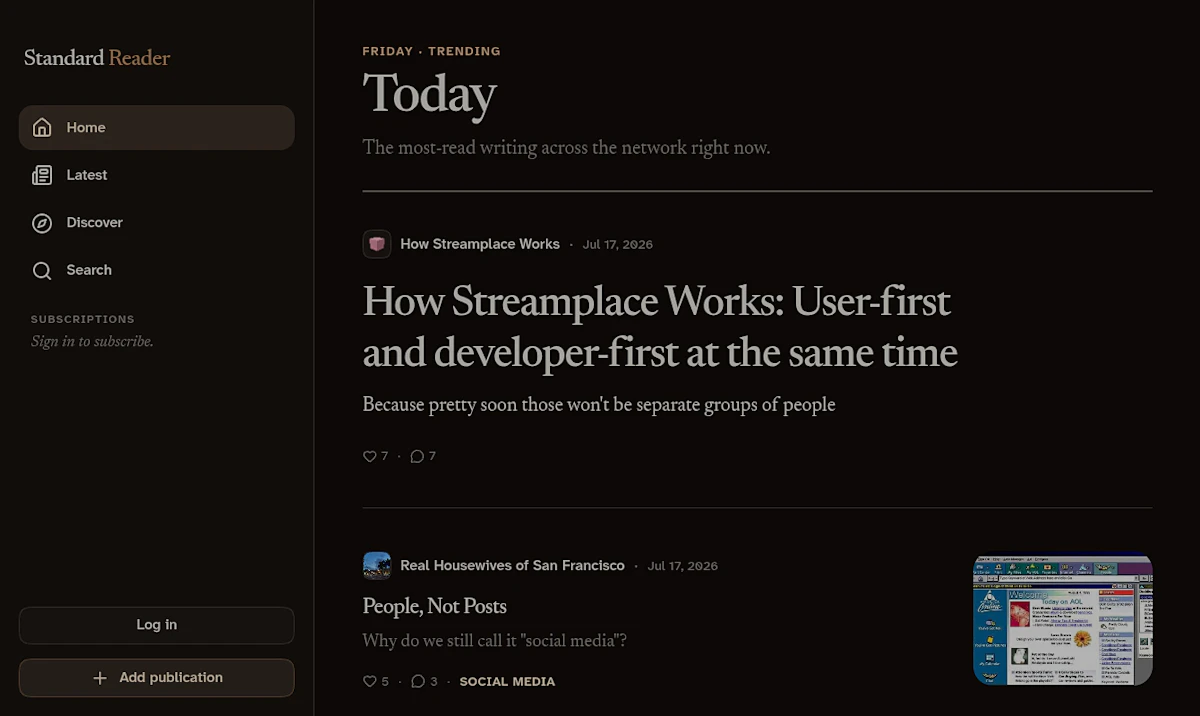
7 Reasons Why Standard Reader Is My Choice
Table of Contents
Standard Site is the ATmosphere network's standard format for long-form publishing. Think of it as a blueprint that anyone who wishes to publish articles or blogs should follow to ensure different apps can read and display their content. To put it another way, it is like a building code guaranteeing the minimum requirements for interoperability between various apps, platforms, and services.
One such app is Standard Reader by Andrew Lisowski, one of the co-founders of Graze Social.
What is Standard Reader
It is the Google Reader of the ATmosphere network. If the classic Google Reader read syndication feeds based on the W3C Atom standard and the old RSS format, Standard Reader reads and displays Standard Site data.
Standard Reader is the Google Reader of the ATmosphere network.
Why do I like it
Here are seven reasons why I like Standard Reader:
1. It is super fast
It loads within the first few seconds on an entry-level Android 14 mini-tablet running a minimal, lightweight Via browser. To put it simply, it performs well despite very limited processing power, RAM, and specs, that would crash the browser or the gadget itself.
2. It prioritizes Markdown
I love this one. If a Standard Site article contains Markdown under the custom $type: "at.markpub.text", Standard Reader displays it natively. You can enjoy the article directly inside the app instead of being forced to open the external website in a new browser tab. This is, of course, assuming the settings Open posts externally is toggled off.
3. Obsidian-Flavored Markdown
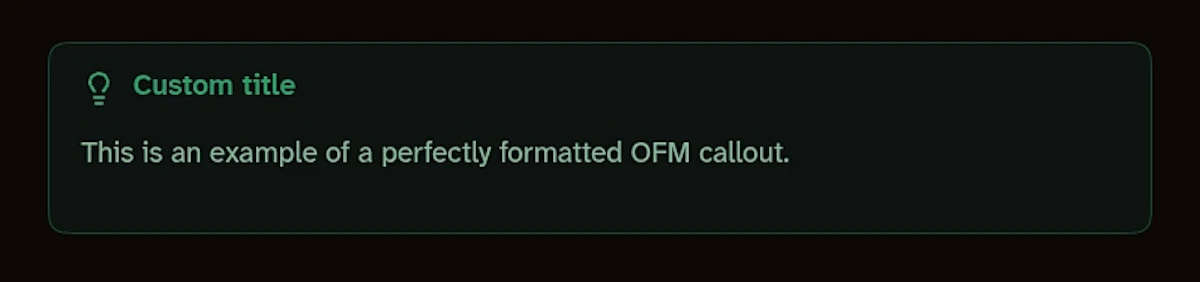
Standard Reader leverages Obsidian-Flavored Markdown (OFM), opening up rich layout options for Markdown writers like myself. For example, if you write OFM-style callouts, it is rendered beautifully directly on Standard Reader.
[!TIP] Custom title
This is an example of a perfectly formatted OFM callout.
It looks like this:
4. Author Follow feature
The author follow feature allows you to follow authors and discover what they are liking or recommending. This helps in discovering great reads, new authors, and interesting blogs.
5. Easy-to-use interface
The UI is clean and not confusing. All global settings are in a single place, and all profile settings are in your profile page. When you want to dig into a creator's profile, their author page neatly divides their articles, publications, subscriptions, readers, lists, and recommendations, into tabs. There is more! These tabs can be toggled off for privacy.
6. Moderation labelers
A very useful feature for filtering the thousands of articles and hundreds of blogs floating around the ATmosphere network. There are three options: Off, Warn, or Hide. I always use Warn because I want to still have the final decision especially since there will always be false-positives. Not to mention, I want to know if my own blogs and articles were accidentally flagged.
7. Trending articles and blogs
I want to keep tabs on what is happening in the ATmosphere network, who is who, and what people are talking about. In the 20th Century, this was called "current events", and it helped me a lot in school to stay on top of things because teachers would randomly ask questions about it and give bonus points. Seriously, it is always good to have some information about anything, even if it is not interesting, and the trending feature is a good source for that.
In closing
There are other features Standard Reader offers, but I have yet to use those thoroughly. To mention two: Collections/Magazine and the various discovery and recommendation blocks in the footer of each article.
Standard Reader is very young, and yet it convinced me that it is the right tool for me to consume Standard Site content in the ATmosphere network. It is not perfect, but improvements are always being implemented. For me, Standard Reader is the Google Reader of the ATmosphere network.
If this work has informed, been useful, or saved you time, please consider sending a tip. 🙇🏽 Your support keeps this sustainable. 🖖🏽
〈7 Reasons Why Standard Reader Is My Choice〉 © 2026 Yohan Yukiya Sese Cuneta.
License: Creative Commons Attribution-ShareAlike 4.0 International (CC-BY-SA-4.0), except where noted.